 +371 2022 8895
  info@lynxgear.lv



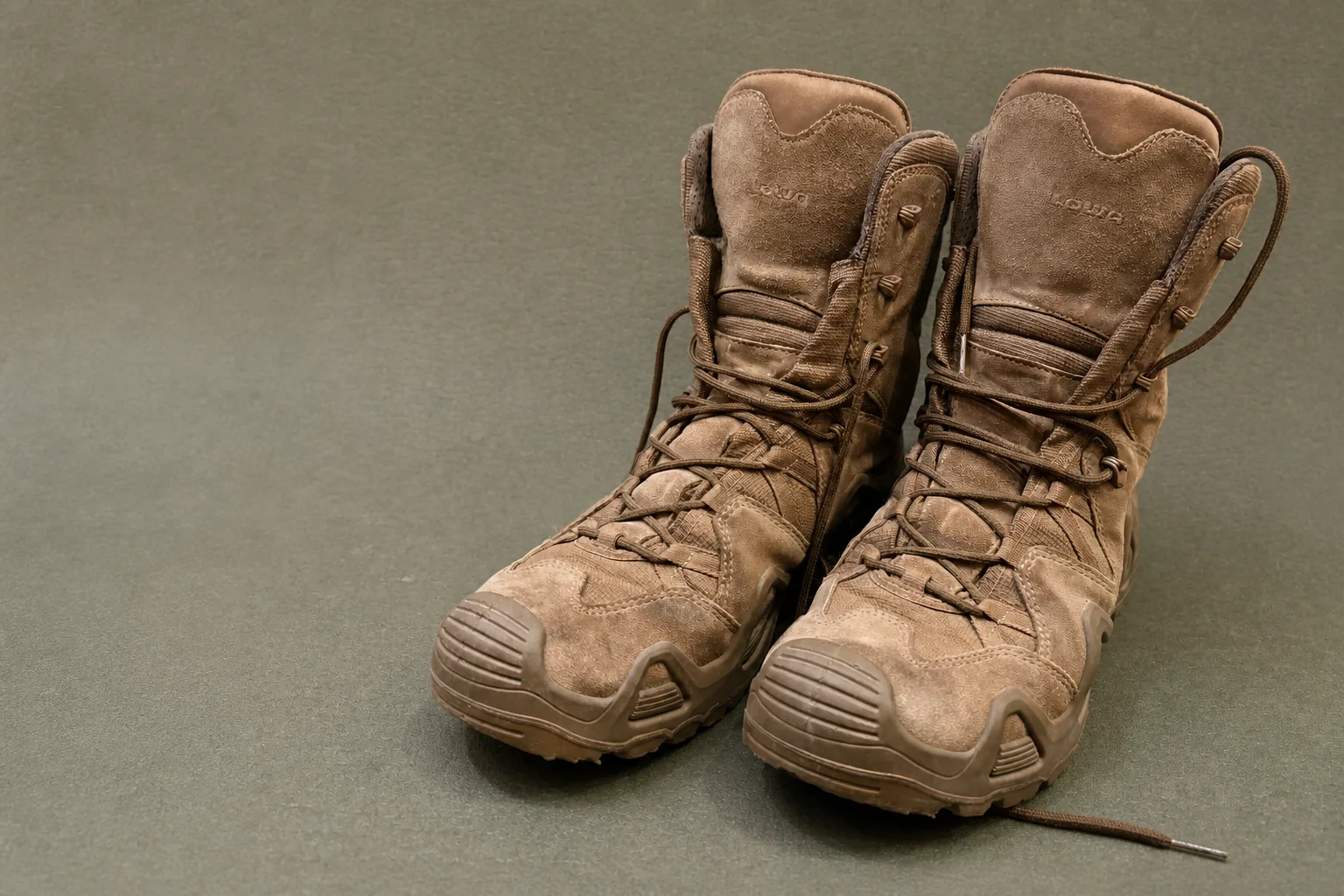
Check Your Boots Before Autumn – Simple Tips for Hunting, Training and Hiking
As autumn approaches, a busier period begins for hunters, participants in military training and people heading out on hikes or taking part in other outdoor activities. In Latvia, it also means more rain, mud and moisture, as well as lower temperatures.
August and the beginning of autumn are therefore a good time to inspect equipment that may have been sitting in a cupboard for several months. Boots should be among the first items you check.
Based on my own experience of using various LOWA and AKU tactical boots, AKU and Chiruca hunting boots, and ECCO, AKU and Zamberlan footwear for everyday use and hiking over many years, I can say that the external appearance of a boot does not necessarily reveal its actual technical condition.
Boots that were put away in spring with the thought that they were “still perfectly good” may not be in the same condition in autumn as we remember them.
Start with a thorough inspection of your boots
Before cleaning your boots, simply inspect them carefully. Check:
- whether the outsole is excessively worn;
- whether the sole is beginning to separate from the boot anywhere;
- whether the protective rubber rand is damaged or coming unstuck;
- whether any seams have opened;
- whether there are deep cracks in the leather;
- whether any textile sections are torn;
- whether any lace hooks or loops are damaged;
- whether the laces are almost worn through;
- the condition of the boot’s inner lining;
- whether the insole is deformed or excessively worn.
Older boots deserve particular attention, even if they have seen relatively little use. Some materials used in boot construction continue to age while the footwear is sitting in a cupboard. “Barely used” does not therefore always mean “almost new”.
One of our customers had an experience that illustrates this well. He owned an older pair of hunting boots that looked good and had seen relatively little use. On the morning of a hunt, he put them on for the first time after a long break. By the time he reached his car, the soles had fallen off both boots.
Older boots should therefore not be worn for the first time on the morning of a hunt or training exercise.

Remove the insoles and inspect the inside of the boots
It is worth removing the insoles for more than just cleaning. Check whether they have become very thin, compressed or deformed. Sometimes a person complains that boots which used to be comfortable no longer feel right, even though the boots themselves have not changed significantly. The cause may simply be a worn-out insole.
Removing the insoles has another practical benefit: the boots ventilate and dry much more effectively.
During training exercises, especially when staying in a tent or in the forest, I always remove the insoles from my boots in the evening. This improves air circulation inside the boots and allows the insoles to dry separately.
Do not leave dirt on your boots until the next season
Mud, sand and other dirt on a boot are more than a cosmetic problem. Once the boot is dry, most dirt can be removed with a soft brush. More persistent dirt can be cleaned with a damp cloth, a brush and a cleaning product suitable for the particular material.
Aggressive chemicals and excessively stiff brushes should not be used. Technical hiking, hunting and tactical boots should also not be placed in a washing machine or cleaned with a pressure washer. High pressure, temperature and mechanical action can damage the materials, bonded areas and other parts of the boot’s construction.
A good hiking or tactical boot is not a car wheel. A pressure washer is not the best way to remove mud from it.
Do not dry wet boots with intense heat
One of the most common mistakes is trying to dry wet boots as quickly as possible.
A radiator, hot stove, open fire or another powerful heat source may seem very tempting, especially after a long day in the rain. Excessive temperatures, however, can permanently damage the boot’s materials.
Boots are best allowed to dry naturally in a dry, well-ventilated place, with their insoles removed and the boots opened as widely as possible.
Signs of damage caused by excessive heat may include:
- the boot or individual parts of it have become deformed;
- the size or shape of the boot appears to have changed;
- the leather has become unusually hard;
- cracks have appeared in the leather;
- the sole or protective rubber rand is beginning to separate;
- joints have opened or become deformed;
- visible damage to bonded areas.
Particular care should be taken with wet leather boots. Drying leather too quickly can cause it to become hard, deform and begin to crack.
What should you do with wet boots in the forest?
In theory, everything is simple: remove the insoles, place the boots in a dry and well-ventilated room and allow them to dry.
In practice, such a room may simply not be available during military training, hunting or a multi-day hike.
During training exercises while staying in a tent or in the forest, we have used a very simple method: find an old newspaper or another type of absorbent paper, crumple it up and place it inside the boots. The paper absorbs some of the moisture inside the footwear. If the boots are very wet, replace the damp paper with dry paper after a while.
Reusable moisture-absorbing inserts designed for footwear can also be kept in an equipment bag or vehicle for this purpose. They take up little space and can help collect moisture from inside a boot. They do not, however, replace proper drying and air circulation.
If everything stays wet, give your boots a rest
A much less pleasant situation arises during prolonged autumn training exercises when the wet conditions continue for more than one evening. It rains for one, two or three days, the tent and equipment are damp, and there is practically no opportunity to dry anything completely.
In these conditions, it is very useful to bring a second pair of boots if possible.
This does not mean that the wet pair will become completely dry after a few hours in a tent. However, if you remove the insoles, open the boots and allow them simply to stand and ventilate, they will gradually lose a significant amount of the accumulated moisture. You can wear the second pair in the meantime.
After a while, the pairs can be swapped. This prevents either pair from remaining continuously wet and warm on your feet around the clock.
Based on experience from military training, a second pair of boots in prolonged wet conditions is not merely a matter of comfort. It also gives both your feet and the boots themselves at least a short break.
If you do not have a second pair of boots
There is not always enough room in a bag for spare boots. In that case, the main thing is not to try to achieve a perfect result in the field at any cost.
Remove the insoles whenever you are not wearing the boots, allow them to ventilate as much as possible and regularly replace damp socks with drier ones. If possible, dry the wet socks separately.
Remove large pieces of mud and other dirt from the boots, but leave more thorough cleaning and care until proper conditions are available again and the boots can be dried gradually at room temperature.
There is little point in trying to “save” completely waterlogged boots with care products in the middle of a wet forest. First, give them an opportunity to lose as much moisture as possible.
Always follow the instructions provided by the manufacturer of the waterproofing treatment. Some products are intended for a clean, dry surface, while others should be applied to slightly damp material. A muddy boot that has just been pulled from a puddle and is saturated with water is not suitable for experimenting with waterproofing treatments.
In this situation, the best you can do is gently remove the dirt, take out the insoles, provide at least some air circulation, change your socks and wait until you have an opportunity to dry and care for the boots properly.
Leather boots need conditioning, not only waterproofing
Leather loses its flexibility over time. Mud, water, perspiration, temperature changes and mechanical stress only accelerate this process. Leather boots therefore require periodic treatment with a suitable care product.
Products containing beeswax have traditionally been used to care for smooth leather footwear. They can help maintain the leather’s flexibility and improve its ability to resist moisture.
Beeswax is not a universal solution for every pair of boots, however. For nubuck, suede, combined textile and leather boots, or modern footwear with a membrane, the instructions provided by the boot manufacturer should always be considered first.
An unsuitable wax, oil or grease can change the appearance and properties of the leather. The safest choice is therefore usually a footwear care product intended for the specific material.
Practically every major manufacturer of hiking and tactical boots also offers its own care products. AKU and LOWA are two examples. The manufacturer knows which types of leather, textiles, adhesives and other materials have been used in the construction of a particular boot, so its recommended product is usually a good place to start.
Conditioning and waterproofing are not the same thing
These two processes are frequently confused.
The primary purpose of a leather care product is to help keep the leather itself in good condition and maintain its flexibility. A waterproofing treatment, by contrast, is intended to help the boot’s outer material repel water and dirt.
If the outer leather or textile becomes completely saturated with water, the boot becomes heavier, takes longer to dry and is less comfortable to wear — even if its membrane is still preventing the water from reaching your foot.
GORE-TEX does not mean a rubber boot
This is probably one of the most common misconceptions we also encounter in the shop.
A person sees the GORE-TEX name on a boot and automatically assumes that it works like a rubber boot: if it has GORE-TEX, water no longer has anything to do with the rest of the boot’s construction.
That is not the case.
GORE-TEX is first and foremost a brand, not one specific universal membrane. A range of technologies and constructions for clothing, footwear, gloves and other equipment are offered under the GORE-TEX brand. The solutions used in boots also differ according to their intended purpose, including warmer or colder conditions, the intensity of activity and the construction of the boot.
The membrane is located inside the boot’s construction. Leather, textiles, seams, protective materials, bonded areas and other components are still located outside it.
A GORE-TEX boot must therefore still be cleaned and dried, while its outer materials must be appropriately cared for and treated to restore their water repellency.
GORE-TEX refers to a technical waterproof and breathable construction. It does not turn a hiking or tactical boot into a rubber boot.
Check your laces and put some paracord in your bag
Laces tend to wear out gradually, especially where they regularly rub against metal hooks or loops.
Before the season begins, run the laces through your fingers along their entire length and inspect any places where the outer sheath has already worn away.
You can, of course, carry spare bootlaces. I often recommend simply keeping some paracord of a suitable diameter in your equipment bag.
Paracord is more versatile. If necessary, it can replace a broken bootlace, tie or secure equipment and serve many other improvised purposes.
It weighs almost nothing and takes up little space, but when a bootlace breaks in the middle of the forest, a few metres of cord suddenly become very useful.
A boot works together with the sock
Even a very good boot will be uncomfortable when worn with unsuitable socks.
There is no single solution for everyone. Many people prefer merino wool, while others choose modern synthetic socks.
I personally use synthetic technical socks for most of the year. In my experience, their advantage is that they dry relatively quickly. There are also high-quality synthetic thermal socks that continue to provide an acceptable level of warmth for me even when they become slightly damp. In extremely cold weather, I use thicker synthetic thermal socks.
During multi-day training exercises in particular, the ability to replace damp socks with dry ones can be more important than trying to dry wet boots completely overnight.
More important than the “merino or synthetic” debate is ensuring that the sock is suitable for the specific boot, temperature and activity.
Take a simple walk before serious use
Once the boots have been inspected, cleaned and cared for, one more very simple test remains: put them on.
Do not, however, do this for the first time on the morning of a hunt or training exercise.
Wear the same socks you plan to use with the boots and walk a few kilometres.
Pay attention to:
- whether the boot presses anywhere;
- whether the heel moves;
- whether any new pressure points have developed;
- whether the sole feels stable;
- whether anything has started to come unstuck;
- whether the boot remains as comfortable after extended storage as you remember.
This is particularly important for older boots. It is better for the sole to fall off during a one-kilometre test walk near home than on the morning of a hunt or the first day of training.
If the test reveals that the boots have reached the end of their service life and new ones are required, replacements should not be purchased on the last evening before the planned activity. New boots should be tried on in advance with the correct socks and broken in gradually.
Quick pre-autumn boot inspection
Before the hunting season, autumn training or a hike, check:
- the condition of the soles and their attachment to the boots;
- the leather or textile uppers;
- the protective rubber rands;
- the seams;
- the laces, hooks and loops;
- the inner lining;
- the insoles;
- whether the leather requires conditioning;
- whether the water repellency needs to be restored;
- whether the boots have dried completely since their previous use;
- whether they remain comfortable with the socks you intend to wear.
Twenty minutes spent on your boots at home before the season can save you from a much more unpleasant problem in the forest.
A good tactical, hunting or hiking boot is generally not a cheap item of equipment. Proper care helps it last longer, while a timely inspection also reveals the opposite: whether a boot can still be restored or has already reached the end of its service life.